Popular sciences

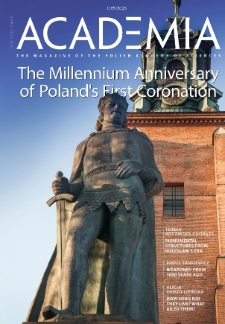
ACADEMIA. The magazine of the Polish Academy of Sciences

Content

ACADEMIA. The magazine of the Polish Academy of Sciences | 2026 | 1 (8) special edition

Authors and Affiliations

Dariusz Jemielniak
1

  1. Vice-President of the Polish Academy of Sciences
Download PDF Download RIS Download Bibtex

Abstract

APolish Nobel Prize will not emerge from a single breakthrough discovery. It will be the result of a system that allows outstanding scientists to do their best work, says Prof. Marek Konarzewski, President of the Polish Academy of Sciences (PAS). In this interview, he discusses the Academy’s new award, Poland’s strongest areas of research, and why investment in science may soon become an economic necessity rather than a political choice.
Go to article

Authors and Affiliations

Marek Konarzewski
1

  1. President of the Polish Academy of Sciences
Download PDF Download RIS Download Bibtex

Abstract

Why does Poland struggle to build a world-class research system? According to Prof. Andrzej Jajszczyk of AGH University of Kraków, former Director of the National Science Centre and former Vice-Chair of the European Research Council Scientific Council, the problem is not simply a lack of money. It is also a system that spreads resources too thinly, sustains too many mediocre institutions and rewards survival more often than excellence.
Go to article

Authors and Affiliations

Andrzej Jajszczyk
1

  1. GH University of Kraków
Download PDF Download RIS Download Bibtex

Abstract

Scientific excellence is, by its nature, selective. You cannot fund everything and everyone equally, says Prof. Anetta Undas of the Jagiellonian University Medical College, a physician, researcher, and member of the Council of Poland’s National Science Centre from 2016 to 2024, serving as its chair in 2024. In an interview with Academia, she explains why Poland needs centres of excellence, stronger international collaboration, and the courage to set higher expectations.
Go to article

Authors and Affiliations

Anetta Undas
1

  1. Jagiellonian University Medical College
Download PDF Download RIS Download Bibtex

Abstract

The Nobel Prize captures the public imagination, but according to Prof. Tomasz Dietl, a theoretical physicist affiliated with the Institute of Physics of the Polish Academy of Sciences and formerly with the University of Warsaw, as well as a recipient of the Foundation for Polish Science Prize, it is a poor measure of the quality of a country’s scientific system. Nobel Prizes are rare, unpredictable and heavily influenced by what he calls the “law of small numbers.” A better measure, he argues, is whether a country consistently produces excellent research and wins competitive international grants.
Go to article

Authors and Affiliations

Tomasz Dietl
1

  1. Institute of Physics of the Polish Academy of Sciences
Download PDF Download RIS Download Bibtex

Abstract

Why is it easier in Poland to count points than to produce a Nobel laureate? According to Prof. Jacek Kuźnicki, a neurobiologist at the International Institute of Molecular and Cell Biology in Warsaw, a corresponding member of the Polish Academy of Sciences and former Chair of the Council of the National Science Centre, the answer cannot be reduced to funding alone. The deeper problem lies in a system that does little to support people who rise above the average.
Go to article

Authors and Affiliations

Jacek Kuźnicki
1

  1. International Institute of Molecular and Cell Biology in Warsaw
Download PDF Download RIS Download Bibtex

Abstract

When truly important research begins, nobody says, “This will lead to a Nobel Prize.” More often than not, researchers do not even know whether anything useful will come out of it. That is how Prof. Dorota Gryko of the Institute of Organic Chemistry of the Polish Academy of Sciences describes the reality of scientific discovery. In her view, Nobel Prizes cannot be planned, commissioned or strategically engineered. They emerge from fundamental research, often in unexpected ways, and almost always in hindsight.
Go to article

Authors and Affiliations

Dorota Gryko
1

  1. Institute of Organic Chemistry of the Polish Academy of Sciences
Download PDF Download RIS Download Bibtex

Abstract

The problem is not a shortage of talented researchers. It is a system that rewards stability rather than risk, says Prof. Wojciech Fendler, a specialist in biostatistics and translational medicine and former president of Poland’s Medical Research Agency.
Go to article

Authors and Affiliations

Wojciech Fendler
1

  1. Medical University of Łódź
Download PDF Download RIS Download Bibtex

Abstract

Young Polish mathematicians are winning prestigious European prizes, publishing in leading journals, and working with top international research groups. Yet according to Prof. Tomasz Łuczak of the Faculty of Mathematics and Computer Science at Adam Mickiewicz University in Poznań, the broader situation surrounding the mathematical sciences in Poland is becoming increasingly worrying.
Go to article

Authors and Affiliations

Tomasz Łuczak
1

  1. Faculty of Mathematics and Computer Science at Adam Mickiewicz University in Poznań

This page uses 'cookies'. Learn more