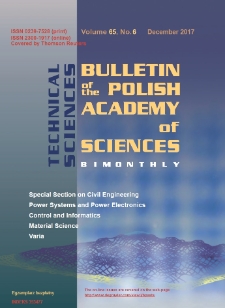
The Bulletin of the Polish Academy of Sciences Technical Sciences has been published bimonthly by the Division IV Engineering Sciences of the Polish Academy of Sciences since the establishment of PAS in 1952. The journal is peer-reviewed and issued in electronic format. It aims to publish original, high-quality papers from multidisciplinary engineering sciences, with preferred topics including:
|
|
Submit your article
| JCR Impact Factor 2024: | 1.1 |
| 5 Year Impact Factor 2023: | 1.0 |
| CiteScore 2024: | 2.7 |
| SCImago Journal Rank (SJR) 2023: | 0.271 |
| Source Normalized Impact per Paper (SNIP) 2023: | 0.517 |
| Ministry of Education and Science: | 100 points |
Abbreviated title: Bull. Pol. Acad. Sci. Tech. Sci.


Guide for Authors
https://www.editorialsystem.com/bpasts/journal/for_authors/
Fees for open access publications in Bulletin of the Polish Academy of Sciences Technical Sciences:
2000 PLN (approx. 500 EUR) - up to 8 pages of the journal format and mandatory over-length charges of 250 PLN (approx. 60 EUR) per page (see the above link with instructions for Authors for details)
Guide for Reviewers
https://www.editorialsystem.com/bpasts/journal/for_reviewers/
Call for Papers
https://www.editorialsystem.com/bpasts/journal/call_for_papers/
Guide for Guest Editors
https://www.editorialsystem.com/editor/bpasts/journal/page1/

 en
en
 pl
pl